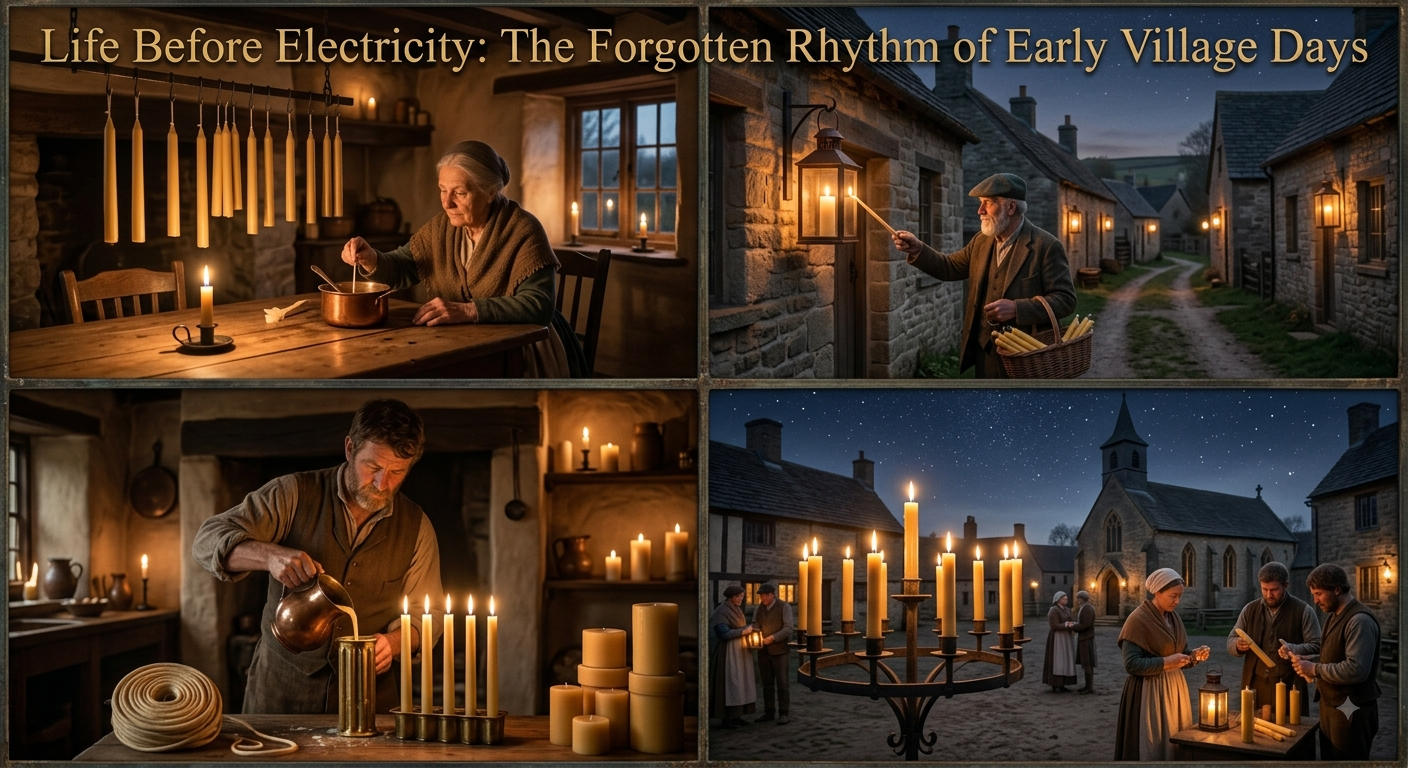
Life Before Electricity: The Forgotten Rhythm of Early Village Days
Step back in time to explore how early rural communities functioned without power grids, landlines, or modern conveniences—relying instead on tallow, candles, shared labor, and the quiet rhythms of nature.
Introduction: The Unplugged Era
In an age where modern civilization runs on an uninterrupted flow of electrons, immediate wireless communication, and instant access to global information, imagining a world entirely detached from the electrical grid feels like stepping into a different realm. Yet, for the overwhelming majority of human history, darkness was a tangible daily reality, communication moved only as fast as a running messenger or a galloping horse, and survival depended on manual ingenuity, seasonal awareness, and deeply knit human bonds.
Before the arrival of transmission towers, high-voltage lines, and landline telephone networks, rural villages existed as self-contained ecosystems. These off-grid communities maintained a lifestyle that modern generations might view as challenging, yet it fostered a profound sense of self-reliance and shared responsibility. Understanding how people lived during these forgotten decades offers essential context for human history and provides a compelling look into the resilience of traditional societies.
Mastering the Shadows: Lighting and Domestic Warmth
The absence of electricity fundamentally altered human relationship with nightfall. When the sun dipped below the horizon, the natural environment plunged into darkness, making artificial illumination both a necessity and a valuable commodity.
Homes were lit primarily through simple, functional means. Candle making was not merely a decorative craft but a vital household chore necessary for winter survival. Families made heavy use of tallow candles—crafted from rendered animal fats—and beeswax taper candles, reserved often for special occasions due to their higher cost and cleaner burn.
- Tallow and Dip Candles: Poured or repeatedly dipped wicks into animal fat provided essential indoor light, despite generating noticeable smoke and odor.
- Oil and Kerosene Lamps: The introduction of glass-chimney lanterns drastically improved safety and light spread, allowing villagers to work, mend clothes, or read long into winter evenings.
- Open Hearth Fires: The fireplace served a dual purpose: providing ambient ambient light for small cottage rooms and acting as the central thermal engine of the household.
Because lighting required continuous effort and expenditure of raw materials, villagers operated on a strict diurnal clock. Waking at dawn and retiring shortly after dark was not merely a health choice; it was an economic strategy designed to conserve fuel and energy.
Water, Hearth, and Sustenance: Daily Domestic Routines
Without electric water pumps, indoor plumbing, or mechanical refrigeration, daily housework required substantial physical effort and precise time management.
Water collection was a primary morning chore. Villagers relied on communal wells, natural springs, or clean running streams. Fetching water meant carrying heavy wooden or metal pails over long distances multiple times a day. Every drop used for drinking, cooking, washing, or livestock care had to be manually lifted, carried, and heated over open flames.
Food preservation techniques were critical for surviving winter months without electrical refrigerators or deep freezers. Communities relied on age-old methods passed down through generations:
- Cellars and Root Stores: Underground rooms held crops like potatoes, carrots, apples, and squash at naturally cool, stable temperatures year-round.
- Curing, Salting, and Smoking: Meats were preserved using salt rubs or hung in smokehouses to prevent spoilage without temperature control.
- Fermentation and Pickling: Vegetables were packed into stoneware crocks with brine or vinegar solution to extend their shelf life for months.
Communication Across Distance: The Human Network
In an era preceding landlines, telegraphs, or cellular towers, messages travelled at the speed of human movement. News did not arrive in real-time updates; it accumulated gradually through word of mouth, travel, and physical correspondence.
When urgency demanded communication between neighboring villages or distant towns, handwritten letters were carried by foot, horseback, or stagecoach. Local hubs—such as the village square, the parish church, the blacksmith forge, and the weekly market—served as the vital conduits for information exchange. Town criers, traveling merchants, and itinerant tradesmen brought news of distant political developments, market prices, and regional events.
This delay in communication created a localized mindset. Decisions were made based on immediate, physical surroundings rather than global occurrences. Trust, accountability, and local reputation formed the backbone of all social interactions.
| Aspect of Life | Pre-Grid Village Era | Modern Era |
|---|---|---|
| Primary Lighting | Tallow candles, kerosene lamps, hearth fire | LEDs, electric bulbs, automated smart lighting |
| Water Access | Manual collection from wells, streams, or springs | Pressurized indoor plumbing and electric pumps |
| Food Storage | Root cellars, salting, drying, smoking, pickling | Refrigeration, deep freezers, electric preservation |
| Long-Distance News | Hand-delivered mail, traveling merchants, word of mouth | Instant cellular networks, internet, global media |
Community Reliance and Shared Labor
Perhaps the most defining characteristic of the pre-electric village was mutual interdependence. Isolated by geography and lacking labor-saving machines, survival was a collective effort rather than an individual pursuit.
Major agricultural undertakings—such as clearing forest land, planting, harvesting, and barn raising—required the combined strength of entire hamlets. If a family faced illness, natural disaster, or crop failure, neighbors provided immediate aid, sharing stored grains or helping rebuild structures.
Social life flourished in these communal settings. Evenings without television or digital screens were filled with storytelling around the hearth, folk music, handcrafting, and community gatherings. The shared experience of working with nature's elements fostered deep-rooted traditions and cultural resilience.
Conclusion: The Enduring Legacy of Village Ingenuity
While modern technology has brought unprecedented convenience, safety, and connectivity, examining pre-electric village life reveals the remarkable adaptability of early human communities. Without electricity or telecommunications, early villagers organized complex, sustainable, and highly functional societies through ingenuity, hard work, and unyielding cooperation.
The quiet rhythm of early village days reminds us that true community resilience is built not on technology alone, but on shared human effort, resourcefulness, and a profound respect for the natural world.