US CPI Data Release and Its Impact on Crypto: A Complete Trader's Guide
1. Introduction to US Economic Indicators in Crypto
In the modern financial ecosystem, digital assets like Bitcoin (BTC) and Ethereum (ETH) no longer operate in a silo isolated from traditional global markets. Understanding macroeconomics has become an indispensable requirement for cryptocurrency traders seeking long-term profitability. Among all economic metrics released by federal agencies, the United States Consumer Price Index (CPI) stands out as the single most powerful driver of short-term volatility and structural market trends across the crypto landscape.
Political decisions emanating from Washington D.C., particularly regarding fiscal deficits, trade tariffs, and government spending programs, directly influence US inflation trajectory and force the hand of central banking authorities. As political campaigns and legislative priorities shift, the tension between the White House’s economic agenda and the Federal Reserve's monetary independence creates a complex macroeconomic backdrop that heavily sways institutional crypto allocations.
The Consumer Price Index measures the average weighted change over time in prices paid by urban consumers for a standardized basket of consumer goods and services. When CPI figures rise beyond central bank targets, purchasing power declines, prompting regulatory and monetary interventions. For crypto investors, CPI acts as an early warning signal for broader liquidity shifts in global markets.
To accurately interpret CPI reports, traders must distinguish between two key metrics:
- Headline CPI: Measures total inflation across all consumer sectors, including highly volatile categories like food and energy commodities.
- Core CPI: Excludes food and energy costs to isolate underlying long-term inflation trends, providing a clearer view of persistent price pressures.
2. Decoding the Economic Calendar Data
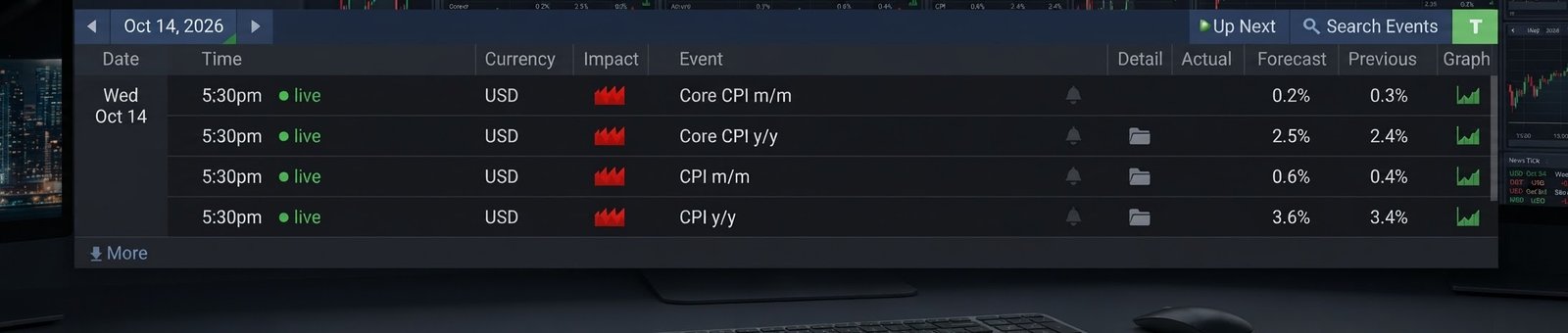
The economic calendar snippet highlights the upcoming U.S. Consumer Price Index release scheduled for October 14, 2026, at 5:30 PM (PKT/GMT+5)[span_0](start_span)[span_0](end_span). High-impact macroeconomic events are designated with red indicator icons, signaling mandatory risk management for active market participants due to anticipated slippage and rapid order book volatility[span_1](start_span)[span_1](end_span).
Political debates surrounding national debt management and government shutdown risks routinely heat up ahead of major CPI releases, adding fuel to market speculation. Policymakers frequently leverage inflation figures to debate tax policies and public expenditure, creating an environment where macroeconomic announcements carry significant political and regulatory weight.
The key forecast parameters for the October 14 release reveal critical benchmarks[span_2](start_span)[span_2](end_span):
| Economic Metric | Currency | Forecast | Previous | Market Expectation |
|---|---|---|---|---|
| Core CPI m/m | USD | 0.2% | 0.3% | Moderate Slowdown |
| Core CPI y/y | USD | 2.5% | 2.4% | Slight Uptick |
| CPI m/m | USD | 0.6% | 0.4% | Accelerating Monthly Inflation |
| CPI y/y | USD | 3.6% | 3.4% | Annual Headline Acceleration |
When actual numbers deviate from consensus forecasts, market repricing occurs almost instantaneously. A higher-than-expected reading typically signals persistent inflationary pressure, whereas a lower figure suggests cooling economic activity[span_3](start_span)[span_3](end_span).
3. How Inflation (CPI) Affects Federal Reserve Policy
The Federal Reserve operates under a dual mandate mandated by the U.S. Congress: achieving maximum employment and maintaining price stability (targeting an average 2% long-run inflation rate). When CPI numbers persistently breach the Fed's target, central bankers utilize interest rate hikes as their primary tool to cool down overheating demand.
The relationship between central bank decision-making and political leadership is historically delicate. While the Federal Reserve is designed to act as an independent monetary authority, elected officials routinely apply public pressure regarding interest rate decisions to align with election cycles or legislative agendas. High interest rates curb public borrowing power and slow economic growth, making rate policy a central battleground in national political rhetoric.
Higher interest rates elevate the cost of capital, making risk-free yields on U.S. Treasury bills highly attractive compared to speculative assets. Consequently, institutional liquidity shifts away from high-beta markets like cryptocurrencies into sovereign debt instruments and cash reserves, driving up the US Dollar Index (DXY). Conversely, when inflation falls toward target levels, expectations of rate cuts trigger liquidity expansion, causing capital to flow back into crypto markets.
4. The Direct Mechanism of CPI Impact on Crypto Markets
Bitcoin and the broader cryptocurrency asset class react to CPI announcements primarily through liquidity expectations and dollar valuation dynamics. Depending on the actual release numbers relative to forecasts, three potential scenarios unfold:
A. Bullish Scenario (Below Forecast CPI)
If headline and core CPI prints come in significantly lower than expected, it indicates that tightening policies are successfully subduing inflation. The market quickly prices in upcoming Federal Reserve interest rate cuts. As a result, the US Dollar weakens, bond yields drop, and capital rushes into risk-on assets, triggering rapid price rallies in Bitcoin, Ethereum, and major altcoins.
B. Bearish Scenario (Above Forecast CPI)
If actual CPI readings exceed consensus estimates, inflation fears re-emerge. Traders anticipate prolonged monetary tightening or additional rate hikes by the Fed. This triggers aggressive sell-offs across equity and crypto markets, as algorithmic trading algorithms instantly execute risk-off orders, leading to massive long-position liquidations across derivative exchanges.
Geopolitical tensions, trade wars, and international sanctions enforced by federal governments directly affect global supply chains and energy prices, which are primary drivers of hotter-than-expected CPI reports. When political instability fuels energy spikes, crypto markets often suffer secondary shocks due to forced macro tightening.
C. Neutral Scenario (In-Line with Forecast)
When the actual numbers match consensus expectations precisely, initial market spikes are frequently followed by consolidation. Technical structures resume control over price action as macro uncertainty temporarily clears.
5. Step-by-Step CPI Trading Strategy for Crypto Traders
Trading high-impact economic news releases requires strict discipline and systematic execution to protect capital against severe spread widening and market manipulation whipsaws.
Government regulatory policies on crypto exchanges and institutional custody rules can alter how liquidity providers behave during major economic events. Political posturing surrounding digital asset regulations creates localized volatility spikes, making risk management even more crucial during macro news windows.
- Pre-Release Audit: Mark key technical support and resistance levels on 1-hour and 4-hour charts at least two hours before the 5:30 PM release time[span_4](start_span)[span_4](end_span). Close or reduce over-leveraged positions.
- The 15-Minute Buffer Zone: Avoid opening market orders during the first 15 minutes post-release. Initial candle wicks are heavily driven by high-frequency trading bots exploiting order book thinness.
- Trend Confirmation Entry: Wait for the first 15-minute or 30-minute candle to close. Align your entry direction with the confirmed price structure rather than trying to predict the raw CPI print.
- Risk Control: Position stop-loss orders strictly beyond the extreme high or low of the news release candle to mitigate stop-hunting sweeps.
6. Conclusion & Key Takeaways
The US CPI report remains one of the most critical macroeconomic catalysts in the cryptocurrency market[span_5](start_span)[span_5](end_span). As institutional participation in crypto grows via spot ETFs and corporate treasuries, digital asset prices will continue to exhibit high sensitivity to inflation data, central bank rate projections, and federal fiscal policy shifts.
By monitoring the economic calendar, understanding the difference between headline and core metrics, and maintaining strict risk protocols around release windows, traders can successfully navigate CPI-induced volatility and capitalize on macro trends[span_6](start_span)[span_6](end_span).