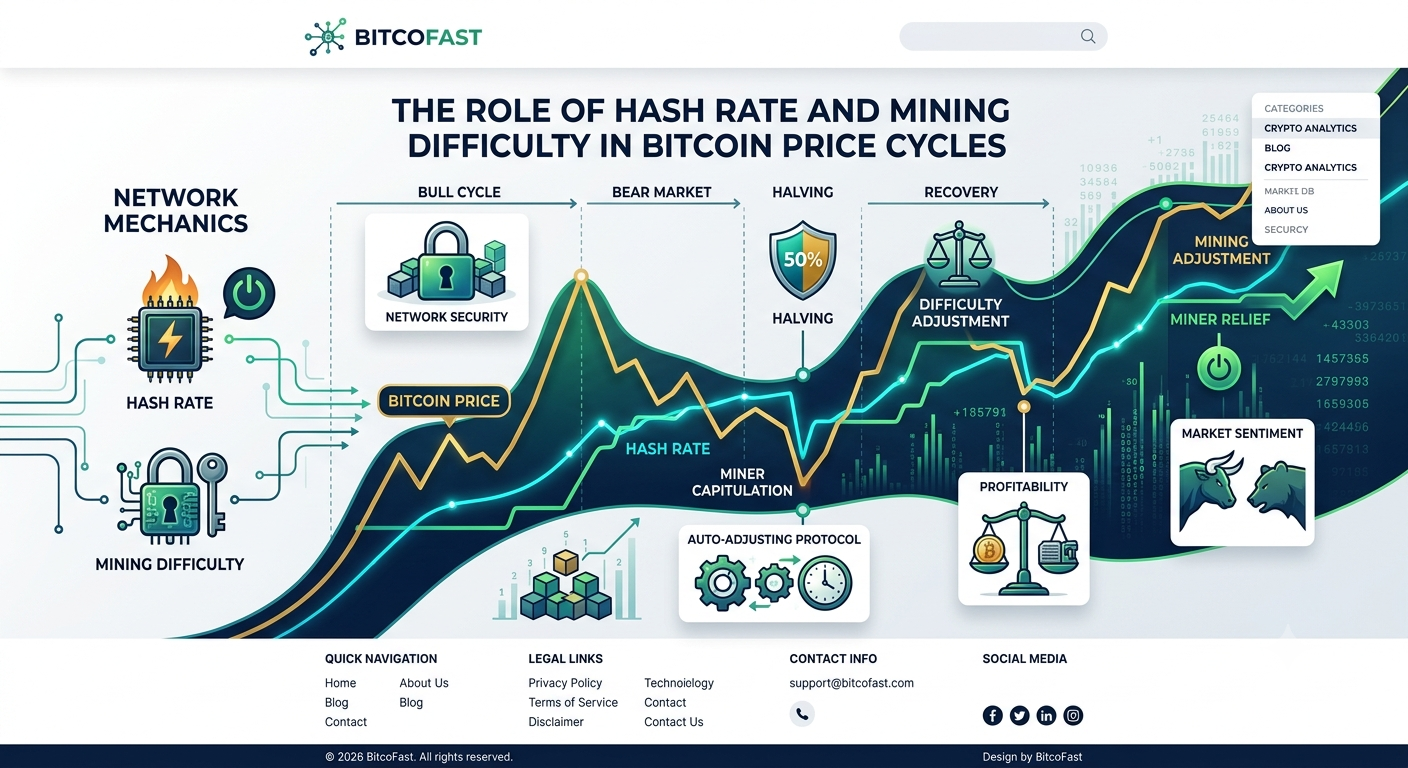
When analyzing the long-term valuation trajectory of Bitcoin (BTC), retail investors and technical analysts frequently focus on short-term chart patterns, momentum indicators like the Relative Strength Index (RSI), and macro market sentiment. However, the true fundamental backbone of the Bitcoin network lies beneath the price action—measured through two interconnected, protocol-enforced metrics: Hash Rate and Mining Difficulty.
These core technical metrics govern network security, dictate the economic realities faced by global industrial mining operations, and enforce Bitcoin's programmatic supply issuing model. Understanding how computational power, cryptographic difficulty adjustments, and miner economics interact provides a powerful framework for identifying macro market bottoming zones, structural support floors, and multi-year bull cycle expansions.
1. What is Hash Rate and Why Is It Vital for Network Health?
The Hash Rate represents the total aggregate computing power dedicated to securing the Bitcoin network through its Proof-of-Work (PoW) consensus mechanism. Expressed in exahashes per second (EH/s)—where one exahash equals one quintillion calculations per second—it measures how many cryptographic SHA-256 operations miners perform globally every second to solve valid blocks and verify transactions.
A expanding hash rate is the premier operational metric for evaluating Bitcoin's security and institutional adoption. Its key implications include:
- Unprecedented Network Security: A higher hash rate makes it exponentially more expensive for malicious actors to execute a 51% attack or attempt transaction rollbacks. As the hash rate rises into hundreds of exahashes, compromising the network requires capital resources exceeding the capabilities of individual corporations and sovereign nations.
- Long-Term Capital Commitment: Rigs like specialized ASICs (Application-Specific Integrated Circuits) require multi-year investments in hardware, power purchase agreements (PPAs), and facility infrastructure. A rising hash rate signifies deep institutional confidence in Bitcoin's multi-decade viability.
- Minimizing Network Latency and Vulnerabilities: A robust, geographically distributed hash rate ensures that the distributed ledger remains operational, censorship-resistant, and immune to single-point-of-failure risks.
2. The Mechanism of Mining Difficulty Adjustments
Bitcoin was programmatically engineered by Satoshi Nakamoto to produce a new block approximately every 10 minutes. This consistent block discovery rate is critical because it controls the issuance rate of new Bitcoin into circulating supply. However, because computational hardware continuously evolves and new miners enter or leave the network daily, block production speed would naturally fluctuate wildly without an automated balancing mechanism.
To preserve this 10-minute cadence, the Bitcoin protocol incorporates a self-correcting feedback loop known as the Mining Difficulty Adjustment. Every 2,016 blocks—which translates to roughly every two weeks—the protocol automatically evaluates how quickly those blocks were mined:
- Upward Difficulty Adjustments: If total network hash rate increases during the 2,016-block epoch, blocks are discovered faster than the 10-minute target. The protocol automatically increases the difficulty target, making it cryptographically harder to solve subsequent blocks and slowing generation back down to 10 minutes.
- Downward Difficulty Adjustments: If miners power down equipment and total hash rate declines, block times slow down beyond 10 minutes. The protocol lowers the difficulty, making it easier for remaining operators to discover blocks and restoring the 10-minute target.
This decentralized algorithmic regulator ensures that Bitcoin's inflation rate and block delivery schedule remain immutably fixed regardless of technological advancements or market volatility.
3. The Economics of Mining: Marginal Cost of Production
To understand how hash rate and difficulty influence price cycles, one must first understand the financial realities of industrial mining operations. Miners act as the bridge between the physical world (energy, hardware, land) and the digital asset ecosystem.
Mining operational expenses (OpEx) consist primarily of electricity consumption, facility cooling, overhead labor, and debt servicing for capital expenditures (CapEx). Because these costs are denominated in fiat currency (such as USD or EUR), while revenue is generated in newly minted Bitcoin and transaction fees, profitability hinges directly on three variables:
- The current market price of Bitcoin.
- The cost of electricity per kilowatt-hour ($/kWh).
- The current network difficulty relative to the miner's hardware efficiency (Joules per Terahash, or J/TH).
The total energy cost required to mine a single Bitcoin establishes a dynamic Marginal Cost of Production. Historically, when spot price approaches or dips below this average production cost floor, the market enters a critical phase in the supply-and-demand cycle.
4. Miner Capitulation and the "Hash Ribbon" Cycle
During severe bear market downturns or immediately following a quadrennial Halving Event—when the block reward issued to miners is cut by 50%—profit margins shrink rapidly. Inefficient miners operating older hardware or paying higher electricity rates begin operating at a net financial loss.
When operating at a loss becomes unsustainable, a predictable economic sequence occurs known as Miner Capitulation:
Phase 1: Reserve Liquidation and Increased Sell Pressure
In an attempt to maintain operations, pay electricity bills, and service debt, distressed mining entities are forced to liquidate their accumulated Bitcoin reserves. This sudden increase in spot market supply adds significant downward pressure on the price of BTC, often driving the market toward macro cyclical lows.
Phase 2: Rigs Offlining and Hash Rate Contraction
When cash reserves are exhausted, unprofitable operators are forced to turn off their ASICs or liquidate facilities. This results in a sharp, temporary contraction in total network hash rate.
Phase 3: Difficulty Relief and Exuberance Exhaustion
As hash rate drops, the network triggers a downward difficulty adjustment. This lowers the cryptographic threshold, significantly reducing the cost of mining for surviving, highly efficient operators. Once inefficient miners are flushed out and distress selling ceases, the market supply shifts back toward long-term accumulation, laying the foundation for the next bull expansion.
On-chain quantitative models, such as the Hash Ribbons Indicator, track the 30-day and 60-day moving averages of total hash rate. Historically, when the 30-day moving average crosses back above the 60-day moving average—signaling that miner capitulation has ended and hash rate recovery has begun—it has provided one of the most reliable long-term buying signals in Bitcoin's history.
5. The Post-Halving Supply Shock Transmission
Every 210,000 blocks (approximately four years), Bitcoin undergoes its scheduled block reward halving. By reducing the daily issuance of new BTC by half, the protocol creates an immediate supply shock.
However, the price impact of a halving is rarely immediate. Instead, it transmits through the mining layer first:
- Immediate Margin Compression: Mining revenue per block drops by 50% overnight while electricity costs remain unchanged.
- Efficiency Re-allocation: Industrial miners shift capital toward latest-generation, high-efficiency ASICs and seek low-cost stranded energy sources (hydroelectric flare-gas, geothermal).
- Market Re-balancing: As difficulty adjusts and weaker hands exit, the reduced daily sell pressure from miners begins to compound. Over the succeeding 12 to 18 months, fixed demand colliding with restricted daily issuance triggers major price expansion cycles.
6. Hash Rate as a Structural Floor vs. Price as a Short-Term Trigger
A common question among analysts is whether price follows hash rate, or hash rate follows price. The relationship is symbiotic and dynamic across different timeframes:
- Short Term (Price Drives Hash Rate): In the short term, price action dictates mining profitability. A rapid price surge encourages miners to deploy more capital and boot up older machinery, driving up hash rate. Conversely, a sharp market crash causes immediate rig shut-offs.
- Long Term (Hash Rate Anchors Price): In the multi-year macro horizon, expanding hash rate raises the security threshold and structural production cost of Bitcoin. As the capital required to attack or mine the asset increases into the tens of billions of dollars, institutional confidence rises, creating an ascending structural price floor across successive market cycles.
7. Key Metrics for Crypto Analysts to Monitor
For traders and fundamental analysts using the BitcoFast platform, tracking these on-chain metrics offers a clearer view beyond market noise:
| Metric | Primary Function | Cycle Insight |
|---|---|---|
| 7-Day Moving Average Hash Rate | Tracks short-term computational health. | Identifies immediate miner reactions to price swings or power outages. |
| Estimated Difficulty Adjustment (EDA) | Predicts the percentage change for the next epoch. | Signals whether network competition is expanding or contracting. |
| Hash Price ($/TH/day) | Measures total expected daily revenue per unit of compute power. | Highlights overall mining industry profitability and stress levels. |
| Miner Reserve Balances | Tracks the total BTC held in known miner wallets. | Detects early signs of miner accumulation vs. panic selling. |
Conclusion
Bitcoin's architecture is a masterclass in economic game theory. Through the delicate interplay between Hash Rate and Mining Difficulty, the protocol maintains absolute monetary predictability while protecting network security.
Rather than viewing price in isolation, observing miner behavior, difficulty recalibrations, and hash rate growth provides a deeper, highly accurate perspective on Bitcoin's structural evolution. As institutional infrastructure expands and global energy grids integrate Bitcoin mining, understanding these core fundamental cycles remains essential for navigating digital asset markets.