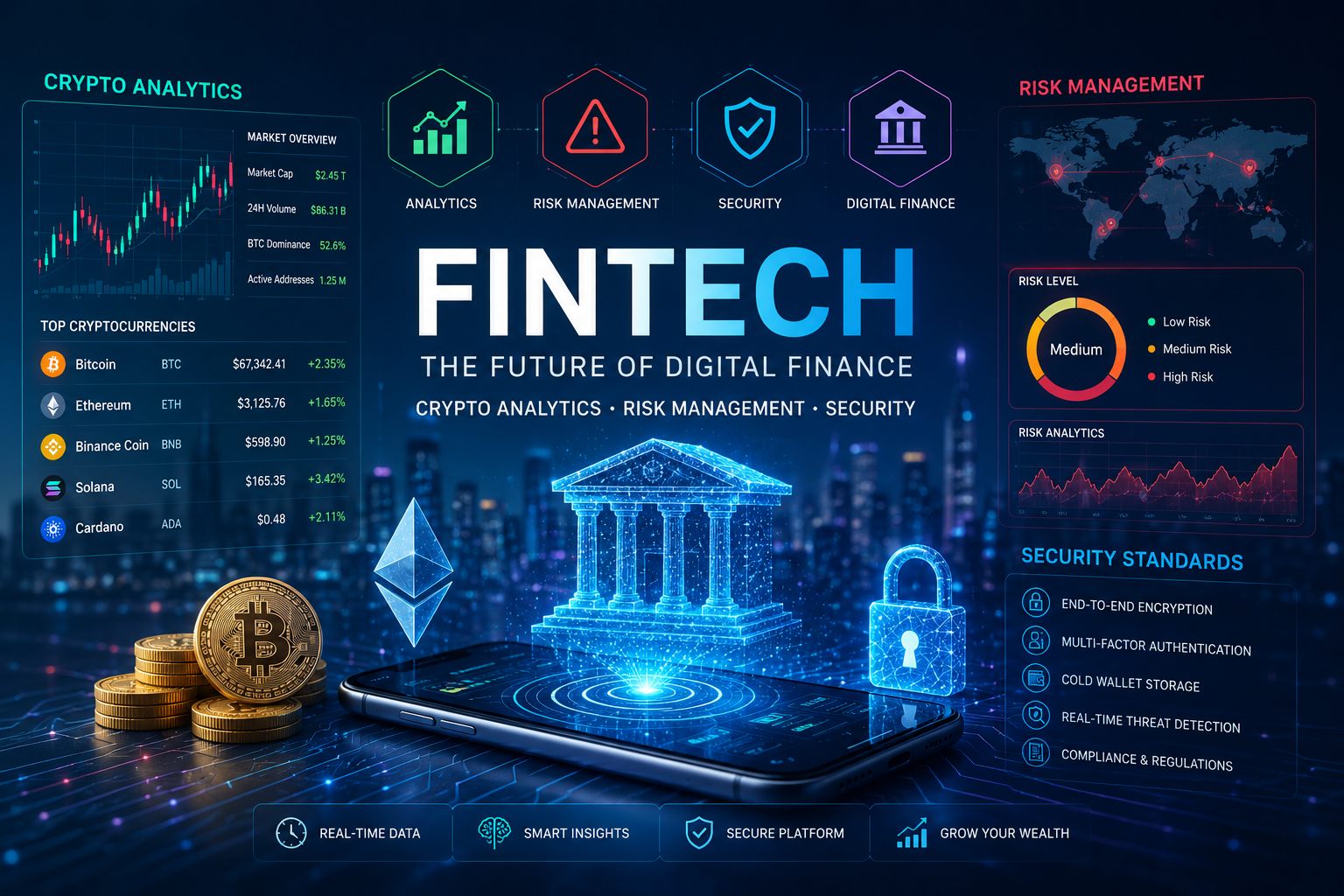
The Future of FinTech: How Crypto Analytics, Risk Management and Security Standards Are Transforming Digital Finance
The financial technology industry has experienced remarkable growth over the last decade. From mobile banking and digital payments to blockchain networks and cryptocurrency platforms, technology is changing the way people interact with financial services. As digital finance continues to expand, four areas have become particularly important: FinTech, crypto analytics, risk management, and security standards.
Modern financial platforms need more than attractive interfaces and fast transactions. They must provide reliable data, protect users from security threats, manage financial risks, and comply with increasingly sophisticated standards. This is why analytics and security have become essential components of the modern digital financial ecosystem.
What Is FinTech?
FinTech, short for financial technology, refers to the use of technology to improve financial products and services. Traditional banking once required customers to visit physical branches, complete paperwork, and wait for transactions to be processed. Modern FinTech platforms can provide many financial services digitally within seconds.
Mobile banking applications, online payment systems, digital wallets, investment platforms, automated financial tools, cryptocurrency exchanges, and blockchain applications are all examples of FinTech innovation.
The major advantage of FinTech is accessibility. Users can access financial services from smartphones and computers without depending entirely on traditional financial institutions.
The Growing Importance of Crypto Analytics
Cryptocurrency markets operate differently from traditional financial markets. Digital assets can trade continuously, prices can change rapidly, and blockchain transactions are recorded on public networks. This creates enormous amounts of data that can be analyzed.
Crypto analytics uses blockchain data, market information, transaction activity, wallet behavior, trading volume, liquidity information, and other indicators to understand digital asset markets.
Analytics platforms can help users monitor important information such as:
- Cryptocurrency price movements
- Trading volume
- Market capitalization
- Wallet activity
- Blockchain transactions
- Liquidity levels
- Token supply
- Large transaction activity
- Market trends
- Potential risk indicators
By combining these data points, investors and businesses can develop a better understanding of market conditions.
Why Data Matters in Digital Finance
Financial decisions have always depended on information. The difference today is the amount of information available. Digital financial platforms can process enormous datasets in real time.
Advanced analytics can identify patterns that may not be obvious through manual observation. For example, changes in trading volume, liquidity, transaction activity, and wallet movements can provide useful context when evaluating a digital asset.
However, analytics should not be treated as a guarantee of future performance. Market conditions can change unexpectedly, and historical patterns do not guarantee future results.
Risk Management in FinTech
As financial services become increasingly digital, effective risk management becomes more important. Financial platforms face many different types of risk, including market risk, operational risk, cybersecurity risk, liquidity risk, fraud risk, and regulatory risk.
A strong risk management framework attempts to identify potential problems before they cause significant damage.
Market Risk
Market risk occurs when the value of an asset changes because of market conditions. Cryptocurrency markets can experience particularly high volatility, making market risk an important consideration for digital asset platforms.
Cybersecurity Risk
Digital financial platforms are attractive targets for attackers because they may handle valuable financial information and assets. Security controls such as multi-factor authentication, encryption, secure APIs, access controls, monitoring, and regular security testing can reduce exposure.
Operational Risk
Operational risk can arise from software failures, infrastructure problems, human errors, incorrect configurations, or service interruptions. Reliable systems should include monitoring, backups, recovery procedures, and well-defined operational processes.
Liquidity Risk
Liquidity risk occurs when an asset or financial position cannot be converted into cash or another asset efficiently without significantly affecting its value. Monitoring liquidity can therefore be an important component of digital asset risk management.
The Role of Blockchain Technology
Blockchain technology is one of the most influential developments associated with modern digital finance. A blockchain can provide a distributed record of transactions that can be independently verified according to the rules of the network.
Blockchain technology can support applications involving digital payments, tokenization, decentralized applications, digital ownership, and financial infrastructure.
However, blockchain technology does not automatically make a financial product safe. Applications built on blockchain networks still require secure software development, appropriate governance, monitoring, and risk controls.
Security Standards for Modern Financial Platforms
Security should be considered from the beginning of product development rather than added after a platform has already been launched.
Important security practices can include:
- Strong authentication
- Multi-factor authentication
- Encryption of sensitive information
- Secure password storage
- Role-based access control
- API authentication and authorization
- Security logging and monitoring
- Regular vulnerability assessments
- Secure software development practices
- Backup and disaster recovery procedures
Organizations should also minimize unnecessary access to sensitive systems. Users, employees, and services should receive only the permissions required to perform their responsibilities.
Artificial Intelligence and FinTech Analytics
Artificial intelligence is becoming increasingly important in financial technology. Machine learning systems can process large datasets and identify patterns that may be difficult to detect manually.
Potential applications include fraud detection, customer support, transaction monitoring, financial forecasting, risk analysis, and anomaly detection.
Nevertheless, AI systems require careful governance. Incorrect data, biased models, unexpected market conditions, and false signals can produce unreliable results. Human oversight and appropriate validation remain important.
Crypto Fraud Detection
The growth of digital assets has also created new opportunities for financial fraud. Fake investment platforms, phishing attacks, malicious applications, fraudulent tokens, impersonation schemes, and compromised accounts can create significant risks.
Crypto analytics can help identify unusual transaction patterns and potentially suspicious activity. Combining blockchain monitoring with traditional security controls can provide a stronger approach to fraud prevention.
Why Transparency Matters
Trust is one of the most important factors in financial technology. Users want to understand how a platform operates, how their information is protected, and what risks they may face.
Transparent platforms should clearly communicate fees, terms, risks, privacy practices, security measures, and important product limitations.
Transparency is especially important when dealing with cryptocurrency and other volatile digital assets because users may incorrectly assume that technology eliminates financial risk.
The Future of Digital Finance
The future of FinTech is likely to involve greater integration between artificial intelligence, blockchain technology, cloud computing, cybersecurity, real-time analytics, and digital payments.
Financial platforms may increasingly use automated analytics to monitor markets and transactions while security systems continuously evaluate potential threats.
At the same time, regulators and financial institutions are likely to continue developing frameworks for digital assets, data protection, cybersecurity, and financial services.
Conclusion
The evolution of FinTech is creating new opportunities across the global financial ecosystem. However, innovation must be supported by responsible risk management, reliable analytics, strong cybersecurity, and transparent business practices.
Crypto analytics can provide valuable information about digital asset markets. Risk management can help organizations identify and control potential threats. Security standards can help protect financial platforms and their users.
The strongest digital financial platforms will not simply focus on growth. They will combine innovation with security, transparency, reliability, and responsible financial practices.