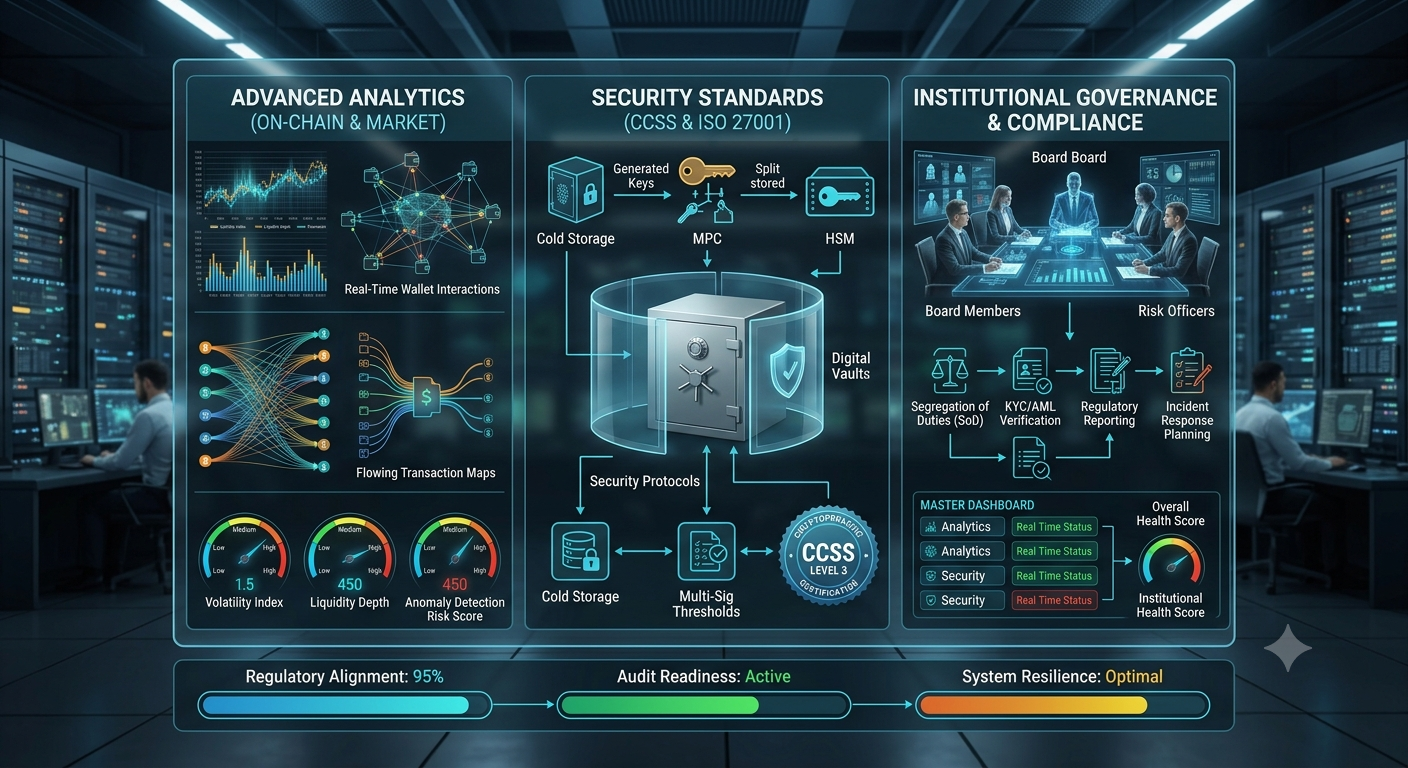
The rapid evolution of digital assets has brought cryptocurrency from the fringes of experimental cryptography into the core of modern financial technology. Institutional investors, retail brokerages, and decentralized protocols now process hundreds of billions of dollars in daily transactions. However, this transition has exposed structural vulnerabilities unique to distributed ledger technologies (DLT). Unlike traditional financial systems (TradFi), where transaction reversal mechanisms, centralized clearinghouses, and standardized oversight provide structural safety nets, the crypto domain operates on immutability, programmatic execution, and pseudonymous participation. Consequently, risk management and security standards must evolve from reactive measures into proactive, continuous dynamic protocols.
Building a resilient framework for crypto risk management requires an integrated approach. Organizations must synthesize real-time data analytics, hard-coded security standards, robust smart contract auditing, and institutional-grade custody architectures. This comprehensive guide details the key vectors of crypto-native risk and outlines the technical infrastructure required to navigate them safely.
1. The Unfolding Landscape of Crypto-Native Risk
To effectively mitigate threats in the crypto landscape, risk managers must categorize risks based on their structural origins within the technological stack. Crypto risk extends far beyond market volatility and credit default.
- Smart Contract Vulnerabilities: Programmatic flaws, reentrancy attacks, flash loan exploits, and arithmetic overflows within decentralized applications (dApps) represent direct vectors for asset loss. A single logic flaw in an automated market maker (AMM) or lending pool can drain millions of dollars in seconds.
- Counterparty and Exchange Risks: Counterparty risk involves centralized entities, custodians, and off-chain liquidity providers. Mismanagement of customer reserves, re-hypothecation, and commingling of funds remain key drivers of counterparty collapse.
- Operational and Custodial Risks: Loss or compromise of private keys—whether through social engineering, insider threats, or improper key generation—results in irreversible asset loss.
- Compliance and Regulatory Risks: Evolving anti-money laundering (AML), know-your-customer (KYC), and combatting the financing of terrorism (CFT) frameworks globally create compliance hurdles. Interacting with sanctioned addresses or privacy-enhancing tools can expose entities to severe legal liabilities.
- Market Microstructure Risks: Liquidity fragmentation across centralized exchanges (CEXs) and decentralized exchanges (DEXs), combined with Maximal Extractable Value (MEV) exploitation and sandwich attacks, distorts true asset valuation and execution efficiency.
2. Leveraging Crypto Analytics for Proactive Risk Management
Public blockchains offer unprecedented operational transparency. Every transaction, smart contract interaction, and wallet movement is etched onto a public ledger. Crypto analytics platforms harness this transparency to convert unstructured raw blockchain data into actionable risk intelligence.
On-Chain Heuristics and Entity Clustering
Raw blockchain transactions consist of cryptographic public keys and hash strings. On-chain analytics engines apply machine learning models, wallet clustering algorithms, and behavioral heuristics to map pseudonymous addresses to real-world entities. By identifying wallet clusters belonging to exchanges, darknet markets, mixers, bridge contracts, and institutional actors, analytics tools establish risk scores for incoming and outgoing funds.
Real-Time Transaction Monitoring and AML Compliance
Automated compliance engines evaluate transactions against real-time parameter matrices. When a wallet interacts with a high-risk address, such as a sanctioned protocol, a known exploit vector, or a high-velocity mixing service, the system triggers real-time alerts. Institutional platforms use these risk scoring engines to automatically freeze deposits or flag outgoing transfers before off-chain settlement occurs.
DeFi and Protocol-Level Health Metrics
In decentralized finance, risk management relies heavily on monitoring protocol-level health parameters. Advanced analytics track variables such as Total Value Locked (TVL) fluctuations, collateralization ratios within lending protocols, pool balance shifts, and oracle latency. Tracking liquidity concentrations allows risk managers to model slippage, stress-test liquidation cascades during extreme volatility, and adjust risk-weighted parameters accordingly.
3. Crypto Security Standards: Frameworks and Best Practices
Data analytics provides visibility, but standardized security protocols supply the structural armor necessary to prevent exploitation. Institutional crypto operations rely on specialized frameworks designed specifically for digital assets, alongside established IT security standards.
Cryptocurrency Security Standard (CCSS)
While traditional security standards like ISO/IEC 27001 and SOC 2 Type II cover general information security and data privacy, the Cryptocurrency Security Standard (CCSS) addresses the management of information storage mechanisms where data controls assets directly. CCSS establishes requirements across ten core operational areas, categorized into three operational levels:
| Security Domain | Key Focus Areas | Implementation Mandate |
|---|---|---|
| Key Generation | Entropy generation, air-gapped systems | Deterministic key derivation in isolated environments |
| Key Storage | Cold, warm, and hot storage segregation | Hardware Security Modules (HSMs) and Multi-Party Computation (MPC) |
| Key Usage | Multi-signature thresholds, timelocks | Multi-actor authorization with geographic distribution |
| Sanitation / Destruction | Seed phrase and key destruction | Verifiable physical and cryptographic media destruction |
Custody Architecture: Hot, Warm, and Cold Segregation
Managing custodial risk requires tiered access architectures to balance operational liquidity with asset security:
- Cold Storage: Deeply offline key management. Keys are generated and stored on air-gapped hardware devices, paper vaults, or offline HSMs. Cold vaults hold the vast majority of assets and require physical access protocols, multi-person authorization, and delay mechanisms for withdrawals.
- Warm Storage: Automated vault structures utilizing Multi-Party Computation (MPC) or Multi-Signature (Multi-Sig) smart contracts. Designed for periodic operational transfers, warm storage implements pre-configured threshold limits and timelocks to mitigate rapid drained-asset scenarios.
- Hot Storage: Online environments designed for automated API executions, automated exchange operations, and dynamic withdrawal fulfillment. Hot wallets carry strict capital limits, automated rebalancing thresholds, and real-time anomaly detection triggers.
Smart Contract Security and Auditing Methodologies
For FinTech platforms deploying smart contracts, security is an ongoing lifecycle rather than a single audit event. A robust smart contract security pipeline includes:
- Static and Dynamic Analysis: Automated linting tools, static analysis frameworks, and dynamic symbolic execution engines detect common vulnerability patterns (e.g., reentrancy, integer overflow/underflow, authorization bypasses) early in the development cycle.
- Formal Verification: Mathematical proofs verifying that code executes strictly as intended under all possible inputs and state configurations. Formal verification is critical for core mathematical logic in automated market makers and vault contracts.
- Third-Party External Audits: Independent audits conducted by specialized blockchain security firms to review protocol logic, edge cases, and economic attack vectors.
- Bug Bounties and Continuous Monitoring: Public bug bounty programs combined with real-time runtime monitoring agents designed to pause contract interactions automatically if unauthorized state manipulations occur.
4. Governance, Compliance, and Enterprise Risk Integration
Technology alone cannot mitigate human and operational risk. Achieving enterprise-grade resilience requires embedding crypto-native technology into formal institutional governance structures.
Organizations must establish clear Segregation of Duties (SoD) across key creation, signature execution, and transaction authorization. No single individual should possess the capability to originate, approve, and sign an asset transfer. Furthermore, disaster recovery and business continuity plans must account for scenario-specific events such as network hard forks, protocol governance attacks, emergency smart contract pauses, and physical key loss scenarios.
Integrating crypto analytics feeds directly into Enterprise Risk Management (ERM) dashboards provides boards and executive teams with consolidated exposure metrics. These dashboards unify market risk, liquidity risk, operational health metrics, and compliance scoring into a single risk management view.
5. Conclusion: Building a Resilient Crypto Stack
The maturation of the crypto asset class relies on the systematic elimination of operational fragility. While distributed ledgers introduce novel financial structures, they demand equally sophisticated risk paradigms. By pairing high-velocity on-chain analytics with rigorous security standards such as CCSS, multi-tiered custody architectures, and continuous smart contract verification, financial institutions and Web3 organizations can build robust operational stacks. Navigating crypto risk requires recognizing that security is not a static endpoint, but an active, continuous process of adaptation, analysis, and execution.